

Virtue ....... Freedom ....... Aspiration ....... Wealth ....... Peace
A MANIFESTO IN THE MAKING
Manifesto Introduction
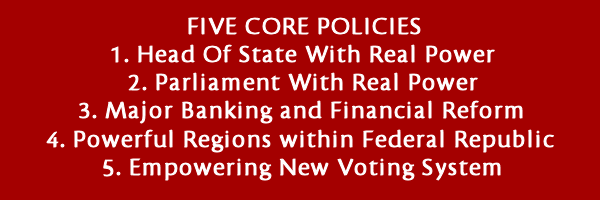
The party defines itself by the five core policies. So that members and non-members clearly understand what the party stands for, these cannot be changed. At present they are principles the details of which will be decided according to the party constitution
All other policies will be decided according to the constitution
Below is a provisional list of headings for the Mani-festo each with a link to a page
That page contains provisional ideas for discussion.
Read this, as work in progress. Only DRP paid up members can comment and so if you want to have your say:
JOIN THE PARTY AND LEAVE A COMMENT !
A NEW CONSTITUTION FOR BRITAIN
Constitution Design
Executive
House of Commons Senate/House of Lords
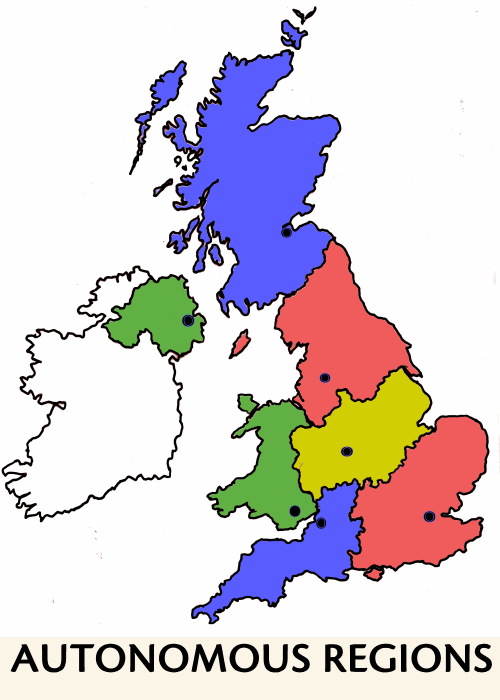
Autonomous Regions
Democracy
Judiciary
Constitutional Court Supreme Court
Functions of Government Public Services Board Monetary Policy Board
ECONOMICS
Banking
Finance
Globalization
Monetary reform
TAXATION
Tax havens
Corporation tax
Income tax
Wealth tax
REGIONS
Federal nation
Autonomous regions
INDUSTRY
Skills training
Industry needs
Business development
Export assistance
PUBLIC SERVICES
Health
Education
Utilities
Transport Road Rail Air
Social Housing
Postal Services, Telecommunications
Police
Fire Service
Prisons
Probation Service
Waste/ pollution
FOREIGN AFFAIRS
Europe
Commonwealth
SOCIETY
Families
Social exclusion
Minorities and race relations,
Citizenship
Economic enfranchisement
Church of England
Civil Society
Deprivation
Youth
Meritocracy
Immigration
Ethical Issues
Humanitarian issues/Animals
Press and Media
NATIONAL PLANNING
National planning strategies
Coordination of regions
Transport
LAW
Justice
Human rights
Liberty
Economic rights
Citizenship
Penal reform
Vice
Drugs
Prostitution
Gambling
CULTURE
Arts
Broadcasting/BBC
Press
POLITICS
Political parties
Corruption
Protest
Political philosophy
HISTORY
SPORT/LEISURE
ENERGY
ENVIRONMENT
AGRICULTURE
CEREMONIAL
CIVIL SERVICE
Government departments
Prosecution Service
ISSUES DISCUSSED IN THE NEWSLETTERS NOT LINKED TO THE MANIFESTO
Whiggism
HISTORY
British Republican History
OTHER NATIONS
3.Reintroduction of building societies
Rising house prices have been a phenomenon of Britain since the Second World War. Britain for about the first decades of this period was doing well economically and there is good reason why house prices should rise when the economy is doing well. For it is as near as you will ever get to a cast-iron, natural, economic law that wherever people have growing incomes there will be growing house prices.
The reason is obvious. As incomes rise so people have surpluses in the household budgets. Some of these surpluses will be saved but not all and the surpluses that are not saved, often as not, go to purchase a family property. As the amount available for this goes up, so house prices go up. This link between earnings and house prices also explains why house prices are higher in the cities than the countryside
It is often argued that house prices rise because of shortages. The so-called “law of supply and demand” is evoked, whereby a lack of supply leads to a higher demand and so to higher prices, to back this claim up. There is clearly sometimes a link between supply and price but history shows us that it is rarely the primary cause. People can only pay so much due to their economic circumstances, and this puts a ceiling on prices in a well-managed, undistorted market.
The situation, we have so far described, applied for most of the period up until the so-called Big Bang of 1985, when the Conservative government, lead by Margaret Thatcher, stripped away at a stroke much of the regulations governing the way banks and other financial companies operated. This started an explosion of house prices which continued, with only short pauses for breath, until the Great Economic Crisis began in 2008. House prices have since softened but they are still high enough to price many out of the market - people who pre-1985 would have normally bought their own house. The situation is extremely unstable as many mortgagees are locked into contracts which will mean that higher interest rates will click in on their loans over the next few years.
And the situation is made more complicated by the fact that London prices are now, not simply a reflection of domestic conditions, but also, very strongly, of buyers from abroad, many from China, placing their savings in London property. This imports inflation of house prices having a distorting effect on the domestic market.
Returning to the period pre-Big Bang, we have said that people bought houses out of their income that was surplus to their weekly or monthly expenditure. There is of course a little more to it than this, for they were also able to take out a loan from a building society to finance their house purchase. Now, the building societies, unlike a bank, could only lend out what they received in deposits. This meant that although some people needed to borrow to buy a house, they were only borrowing from pool of savings which resulted for other people’s savings and so the net effect was that overall it was people’s savings that was used to buy houses. Banks, which have access to money from all sorts of routes, at this time, were banned from lending on private house purchases, and so the relationship between savings and property prices was more or less preserved. With buyers having no access to loans other than from a building society, a lid was kept on prices.
This was an excellent way of managing the housing market. It benefited savers and borrowers alike and often the building societies were highly localised as their names, now still familiar, reveal. (Woolwich, Halifax, Cheltenham, etc). The building societies knew their customers and their patch and so a stable housing market was in place. People still made capital gains on rising house prices as well they should in a prospering economy. But that is the point: house price gains related to the real economy and the purchasing power it naturally had.
Following 1985, the housing market completely changed for banks could enter the market and they brought with them access to far more money than local savers ever could. The British housing market became exposed to predatory global finance that was eager to bet on any market that looked good to them. And it was a win-win situation for as money poured in to the pockets of borrowers to buy houses the prices went up and the traditional linked between savings and house prices was blown away. The increased house prices provided another good bet for predatory finance for as more money flowed in prices just went higher and higher.
This is what happened in last years of the 1980s and the party was only called to a halt when interest rates went through the roof. But the respite was only temporary for as we know house prices continued their upward march until 2008 or thereabouts and from then have remained high and way out of the reach of many. In any bubble of this kind there will be winners and losers but the overall effect on the economy is negative as housing cost become a burden.
What is extraordinary about the housing market since 1985 is that it has lost all sense of contact with the real economy. It is no longer a reflection what people have saved but of what they can borrow. This creates unreality and instability. There is a name for this kind of market; it is called a Ponzi scheme.
A Ponzi scheme can be defined as a market whose price depends, not on intrinsic value, but on there being new entrants into the market or existing entrants take on a larger stake. A well-known recent example was that run by the now imprisoned, Bernard Makoff. Makoff had ran an investment fund whereby people would place money in it and then received excellent returns each year. He produced consistent results over many years and became highly respected for his financial skills. But he was not placing the money, in, say, shares or bonds; he was simply getting more and more people to join his scheme and the “profits” came out of the new entrants’ money.
How he could get away with this for so many years remains a mystery except we have to respect Madoff’s skills as a conman and stand aghast at the naivety of the financial culture around him. This as a classic Ponzi scheme for there was no underlying value in his company. He relied on new entrants or existing entrants increasing their stake in order to generate “income”. Ponzi scheme’s are always a house of cards and in the end always come crashing down.
So it is that the British housing market (it is like most western housing markets, Germany is a notable exception) is nothing more than a giant Ponzi scheme. House prices do not reflect any real value that is related to the real economy. They have just be inflated by a massive injection of money by speculators and all of this has been orchestrated by the banks with the collusion of government policy and the regulators.
Many commentators believe that the British housing market will be a chain around the neck of the British economy for years to come. With foreign money now coming in there is no end in sight
This is why we must change the way houses are bought. We must get rid of bank participation and return to the building society system. Building societies only lend what they borrow and only building societies can loan on house prices. To deal with the problem of foreign money coming in we have to re-impose capital controls on which were done away with by Margaret Thatcher in 1980. (There are other reasons as well for bringing back capital controls - this is just one.)
Rental law
Leave a comment here.
We need your views. Join the debate!
blog comments powered by Disqus
© COPYRIGHT. All content of this website unless otherwise indicated is the copyright of Peter Kellow. You may freely quote and republish content on condition that you acknowledge the author the source and give the link to the website www.democraticrepublicanparty.co.uk